
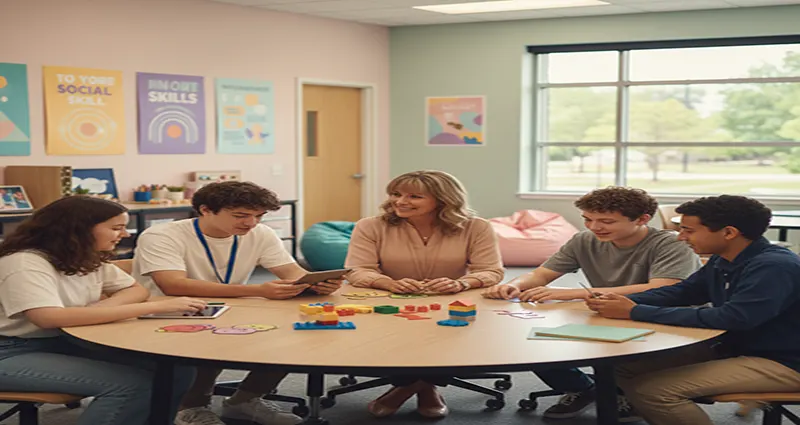
Beyond the Books: Empowering Autistic High Schoolers with Essential Social Skills

The high school environment is a complex and often overwhelming social maze defined by shifting peer dynamics, subtle humor, and unspoken rules. For students on the autism spectrum, navigating this landscape presents formidable and unique challenges. Targeted social skills instruction is not merely a beneficial supplement; it is a critical necessity for ensuring their academic success, bolstering their emotional well-being, and fostering the independence required for adult life.

Understanding the root causes of these difficulties is the first step. Autistic individuals often face hurdles in interpreting non-verbal cues (like facial expressions and body language), struggle with abstract language such as sarcasm or idioms, and find it difficult to execute the complex cognitive task of perspective-taking. While these differences are neurological—not a reflection of a lack of desire for connection—they intensify during the high school years when peer communication becomes more nuanced and social demands skyrocket. Therefore, skills must … Continue reading >>>

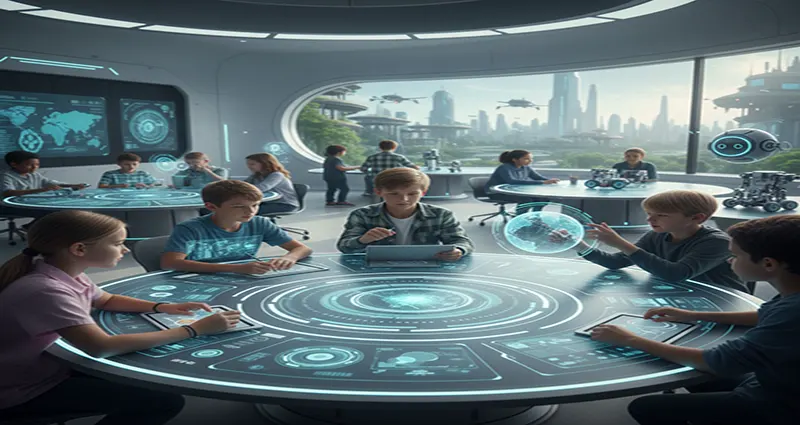
Future-Proofing Education: Equipping Students for Tomorrow’s Undefined Careers

The pace of technological change is staggering. Experts predict that a significant portion of careers held by today’s students have not even been invented yet, driven by advancements in AI, biotech, and sustainability. This reality presents a core challenge to the education system: how do we prepare students for jobs we cannot define? The answer lies not in teaching specific content, which quickly becomes obsolete, but in cultivating durable skills that are transferable across any emerging field.

The most valuable assets for an unknown career landscape are not degrees of knowledge, but degrees of competence. Foremost among these is Critical Thinking and Problem-Solving. We must transition from curriculum focused on recall to models like Project-Based Learning (PBL), which forces students to analyze novel, complex problems and devise original solutions. Equally vital is Adaptability and Flexibility. Future success depends on the “learn-to-learn” mindset—the capacity to rapidly acquire new skills, … Continue reading >>>

Master Your Future: Finding Affordable Online Education Degrees for Busy Teachers

For dedicated K-12 teachers, pursuing a Master’s degree in Education is one of the most effective ways to secure a salary increase, unlock new leadership roles, and stay current with pedagogical best practices. However, juggling a full-time teaching schedule with on-campus classes and managing tuition costs often feels insurmountable. Fortunately, the rise of affordable online Master’s in Education programs has emerged as the ideal solution, dismantling the traditional barriers of time and expense for working professionals.

The flexibility inherent in online learning is the primary draw for busy educators. Programs often utilize asynchronous learning, meaning teachers can complete assignments, attend virtual lectures, and participate in discussions after school hours or on weekends, fitting the studies around their demanding classroom duties. Critically, these programs are often significantly more cost-effective than their campus-based counterparts. Institutions save on physical overhead, and students save on commuting, housing, and relocation expenses. Moreover, many reputable … Continue reading >>>

The AI Tutor: How Personalized Learning is Redefining the Future of Education

The traditional classroom, with its rigid curriculum and standardized pace, often struggles to cater to the diverse learning styles and individual needs of students. This conventional “one-size-fits-all” model can leave some students feeling overwhelmed and others unchallenged. However, a revolutionary shift is underway, with Artificial Intelligence (AI) emerging as the catalyst for personalized learning (PL), poised to fundamentally redefine the future of education.

At the heart of this transformation are Intelligent Tutoring Systems (ITS). These AI-powered platforms meticulously analyze vast amounts of student data, including academic performance, learning pace, and even interaction patterns, all in real-time. Based on this continuous assessment, the systems provide adaptive content, automatically adjusting the difficulty level, presenting information in preferred formats (visual, auditory, kinesthetic), and modifying the instructional path to perfectly align with each student’s unique requirements. This means immediate feedback and tailored resources are always at a student’s fingertips. This crucial … Continue reading >>>