
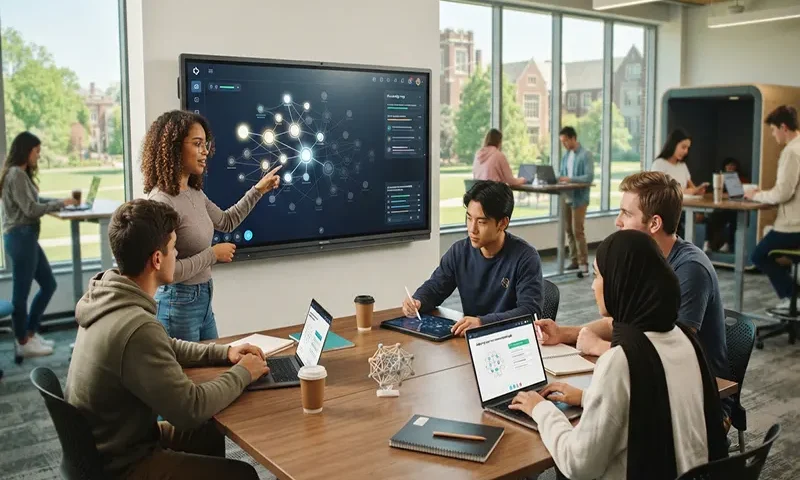
For centuries, the architecture of higher education has remained remarkably consistent: a professor stands before an amphitheater of hundreds of students, delivering a standardized lecture at a single, unyielding pace. In this mass-lecture model, students are treated as a collective uniform entity rather than individuals with distinct cognitive profiles, prior knowledge levels, and learning speeds. Those who grasp complex concepts instantly grow restless, while those struggling with foundational prerequisites quietly fall behind. Today, this industrial-era framework is being dismantled by artificial intelligence. Personalized AI adaptive learning software is sweeping across university campuses, transforming higher education from a rigid sorting mechanism into a dynamic, student-centric ecosystem.
The Mechanics of Adaptive EdTech
At its core, personalized AI adaptive learning software utilizes machine learning algorithms and real-time diagnostic analytics to continuously model a student’s cognitive state. Unlike static digital textbooks or traditional learning management systems (LMS) that present information in a linear sequence, adaptive platforms act as responsive, intelligent co-pilots.
The system begins by evaluating a student’s baseline comprehension through interactive diagnostics. As the student engages with assignments, quizzes, and problem sets, the AI tracks nuanced data points: response times, error patterns, hesitation markers, and conceptual pathways chosen. If a student stumbles on an advanced calculus problem or a complex organic chemistry mechanism, the algorithm instantly diagnoses whether the failure stems from a momentary oversight or a missing foundational concept from a prerequisite course. The software then dynamically adjusts the curriculum in real time, serving up alternative explanations, supplementary micro-lessons, or modified problem sets designed to keep the learner safely within their optimal zone of cognitive development.
Transforming the University Experience
The integration of AI adaptive learning software ripples across every tier of the university ecosystem, redefining the roles of both students and faculty:
Closing Knowledge Gaps Early
In large introductory university courses—often referred to as “weed-out” classes—many students fail not because they lack capability, but because hidden knowledge gaps from high school or earlier semesters trip them up under pressure. Adaptive AI software catches these vulnerabilities instantly. By intervening with targeted remediation before high-stakes midterms or finals, the software prevents minor misunderstandings from compounding into course failures.
Optimizing Faculty Workloads and Pedagogy
A common anxiety among university professors is that educational technology will diminish the human element of teaching. In practice, AI adaptive software achieves the exact opposite. By automating routine grading, tracking attendance metrics, and diagnosing individual student bottlenecks, the software liberates professors from administrative drudgery. Faculty can shift their energy away from repeating basic lecture material to what they do best: leading vibrant seminar discussions, mentoring undergraduate researchers, and serving as deep intellectual guides.
Data-Driven Retention and Student Success
University administrators face immense pressure to improve graduation and retention rates. AI adaptive platforms provide institutions with predictive learning analytics dashboards. Instead of waiting for a failing grade at the end of the semester to identify an at-risk student, administrators and academic advisors receive real-time, aggregated data insights. This allows universities to deploy proactive academic support, counseling, or peer tutoring precisely when and where it is needed most.
Implementation Challenges and Ethical Considerations
Despite its transformative potential, the widespread adoption of AI adaptive learning software in higher education introduces complex hurdles that universities must navigate with caution:
- Data Privacy and Governance: Adaptive platforms collect vast amounts of behavioral, cognitive, and personal data on university students. Institutions must enforce rigorous data security standards, ensuring full compliance with privacy regulations and preventing the commercial exploitation of student data.
- Algorithmic Bias and Equity: If the underlying machine learning models are trained on narrow or biased datasets, the AI may misinterpret diverse learning styles, non-native English speakers, or neurodivergent students. Continuous algorithmic auditing is essential to ensure equitable educational delivery.
- Preserving Critical Thinking: As AI customizes learning pathways, universities must ensure that students are still challenged to grapple with ambiguity, disagree with automated outputs, and develop independent critical thinking skills rather than passively following algorithmic prompts.
Personalized AI adaptive learning software represents a profound paradigm shift for higher education. By replacing rigid, one-size-fits-all instruction with fluid, data-driven, and highly individualized learning paths, universities can honor the unique cognitive journey of every student. When technology handles the logistics of pacing and remediation, higher education can return to its truest mission: cultivating deep intellectual curiosity, resilience, and mastery. University leaders who embrace intelligent adaptation today will build the resilient, high-retention institutions of tomorrow.

