
Step into a traditional industrial-era elementary classroom, and you will likely see rows of silent children sitting at individual desks, staring at a chalkboard while a teacher lectures from the front of the room. Information is treated as a static commodity to be memorized, regurgitated on a Friday quiz, and promptly forgotten.
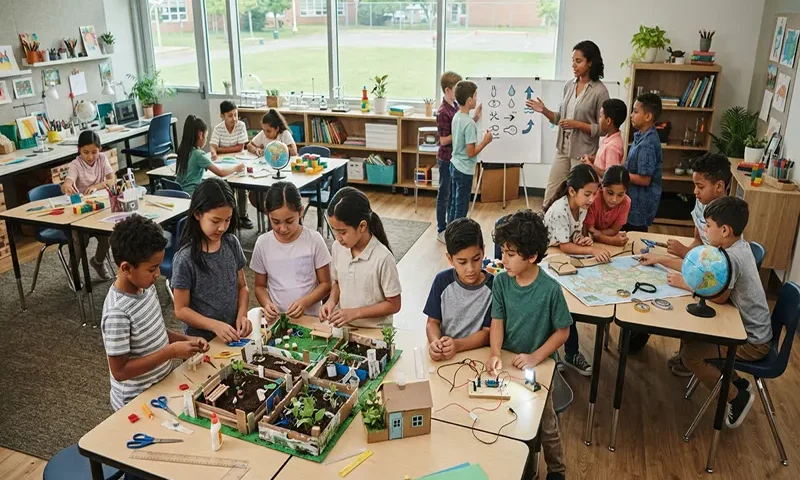
Now, step into a modern elementary classroom guided by the philosophy of pragmatism. The room hums with purposeful energy: children work in small collaborative clusters around a central table, testing hypotheses, debating how to build a stable bridge out of recycled cardboard, or measuring soil moisture for a classroom garden.
Rooted in the foundational ideas of thinkers like John Dewey, educational pragmatism posits that knowledge is not merely something to be absorbed—it is something to be actively tested, constructed, and applied through real-world experience. Far from being an outdated 20th-century theory, pragmatism is the beating heart of today’s most innovative elementary schools.
The Roots of Pragmatism in Early Learning
Pragmatism rejects the notion that abstract, rote memorization constitutes true education. Instead, it asserts that ideas and concepts derive their meaning from their practical utility and real-world consequences. If education is “preparation for life,” pragmatists argue that the best way to prepare children for the world is to let them experience and participate in it directly.
Young children are, by their very nature, natural pragmatists. They do not learn about the physical world by reading a manual on gravity; they learn by dropping blocks, running, splashing, and observing what happens. Pragmatist education harnesses this innate curiosity, transforming the elementary classroom into a living laboratory where children learn through physical manipulation, social negotiation, and environmental interaction.
Modern Classroom Examples in Action
In today’s elementary schools, pragmatic philosophy manifests through vibrant, experiential instructional strategies. Here are four ways pragmatism comes alive in modern classrooms:
1. Project-Based Learning (PBL) and Community Problem Solving
Rather than treating academic subjects as isolated silos—math at 9:00 AM, science at 10:00 AM—pragmatic elementary classrooms use interdisciplinary project-based learning to solve authentic problems.
- In Practice: A third-grade class notices that their school cafeteria is generating excessive food waste. Instead of reading about ecology in a textbook, the students launch a classroom enterprise. They design a composting system, track organic decomposition rates (science and math), draft persuasive letters to the principal (language arts), and calculate the financial savings of waste reduction (practical economics). Knowledge is acquired because it is needed to solve a real problem.
2. Democratic Classroom Governance and Social Collaboration
Dewey famously argued that school should not just be a place to learn about democracy; it should be a democracy in miniature. Pragmatism emphasizes that social habits and civic responsibility are learned through practice, not lectures.
- In Practice: Elementary classrooms implementing pragmatic principles often start the day with a morning meeting where students collectively establish their community norms, resolve peer conflicts, and vote on collaborative project directions. Children learn how to listen to dissenting opinions, negotiate compromises, and take collective responsibility for their shared physical space.
3. Inquiry-Based Science and Experiential Stations
In a pragmatic science lab, textbooks take a back seat to raw exploration. Students do not watch the teacher perform an experiment; they formulate questions, build prototypes, and learn from trial and error.
- In Practice: When learning about kinetic energy and structures, fourth-graders are given a box of random materials—rubber bands, craft sticks, plastic cups—and tasked with building a device that can safely launch an egg across the room without cracking it. When the first three designs fail, the failure is not punished with a low grade; it is celebrated as vital data that drives the next iteration of engineering design.
4. Integrating Modern Makerspaces and Outdoor Labs
Pragmatism adapts seamlessly to modern technological and environmental shifts, expanding the classroom into makerspaces and outdoor learning environments.
- In Practice: Elementary makerspaces allow children to blend tactile craftsmanship with digital literacy—programming simple robotics or designing 3D-printed tokens for a classroom economy. Similarly, outdoor forest kindergartens and schoolyard farming labs ground abstract math and biology in living ecosystems, teaching children sustainable stewardship through direct tactile interaction with nature.
The Evolving Role of the Teacher as a Facilitator
In a pragmatist classroom, the teacher’s role shifts dramatically. The instructor is no longer an authoritarian dispenser of fixed facts standing at the front of the chalkboard. Instead, they act as a facilitator, guide, and co-investigator.
The pragmatic teacher carefully curates a rich, stimulating environment filled with open-ended materials, poses provocative questions, and steps back to watch how children navigate challenges. When students hit a roadblock, the teacher does not provide the answer; they ask guiding questions that prompt the children to test, rethink, and discover the solution themselves.
The philosophy of pragmatism reminds us that elementary education is not about filling empty vessels with standardized trivia; it is about lighting fires of inquiry, resilience, and practical problem-solving. By embedding project-based learning, democratic governance, and hands-on experimentation into our elementary classrooms, we equip children with the ultimate toolset for an unpredictable future. When experience drives understanding, learning becomes not just a chore of childhood, but a joyful, lifelong habit.

