
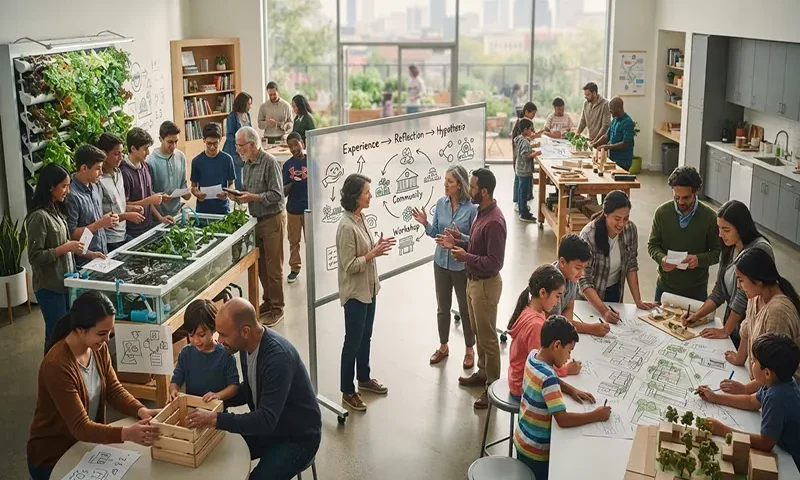
For centuries, formal education was built on a remarkably passive premise: the student was an empty vessel, and the teacher was an authoritative pump pouring standardized knowledge into them. Classrooms demanded quiet obedience, strict memorization, and the regurgitation of abstract facts disconnected from the realities of daily life.
That industrial-era model was radically dismantled by American philosopher, psychologist, and educational reformer John Dewey. More than a century ago, Dewey argued that true learning does not happen when a student sits silently listening to a lecture. Instead, he championed a revolutionary idea: we learn by doing, and education is fundamentally rooted in human experience. Today, Dewey’s philosophical framework serves as the undisputed architectural blueprint for modern experiential learning systems across the globe.
Philosophical Foundations: Pragmatism and “Learning by Doing”
At the heart of Dewey’s philosophy is pragmatism—the belief that the value of an idea, concept, or curriculum must be judged by its practical consequences and utility in the real world. Writing during a time of massive industrial and social upheaval, Dewey observed that traditional schools were failing to prepare children for a dynamic, democratic society.
His most famous maxim, “learning by doing,” was a direct assault on rote memorization. Dewey proposed that thinking does not occur in a vacuum; it is sparked when humans encounter real-world problems that require active physical and cognitive intervention. Furthermore, in his seminal work Democracy and Education (1916), he introduced a radical proposition that shattered traditional academic boundaries: “Education is not preparation for life; education is life itself.” Schooling, in Dewey’s view, should be a lived, active community where students practice democracy and problem-solving firsthand.
The Mechanics of an Educative Experience
Dewey was careful to clarify that not all experiences are inherently educational. In fact, he warned that poorly structured activities could be “mis-educative” if they narrowed a learner’s future curiosity or fostered bad habits. To create a genuinely transformative learning system, Dewey established two foundational criteria:
1. Continuity
Every experience a student undergoes casts a long shadow over future learning trajectories. Continuity means that experiences are strung together in an evolving, upward spiral. A well-designed experiential learning system ensures that a student’s past hands-on projects build directly into more complex, abstract challenges, deepening their mastery over time.
2. Interaction and Reflective Thought
Action alone is not enough; standing in a laboratory mixing chemicals or building a model bridge without cognitive engagement is merely busywork. Dewey argued that true experiential learning requires a dynamic interaction between the internal state of the learner and the external environment. Crucially, this requires reflective thought—taking a step back from the action to analyze consequences, test hypotheses, and extract abstract meaning from physical execution.
Translating Theory Into Modern Experiential Systems
While Dewey conceptualized his theories in the late 19th and early 20th centuries, his vision has found its ultimate expression in contemporary educational systems. Modern experiential learning frameworks are direct descendants of Dewey’s pragmatic philosophy:
- Project-Based Learning (PBL): Rather than studying subjects in isolated academic silos, modern students tackle complex, interdisciplinary challenges—such as designing local sustainability initiatives or engineering community water filtration systems—where academic subjects like math, science, and social studies are learned organically as tools for problem-solving.
- Makerspaces and Innovation Labs: Modern school and university makerspaces embody Dewey’s vision of the classroom as a workshop. Students build prototypes, experience failure as valuable data, and iterate on physical and digital designs through trial and error.
- Immersive Technologies and Digital Simulations: Today, advanced virtual reality (VR) simulations and AI-driven interactive environments scale Dewey’s model for the digital age. Whether medical students practicing surgical procedures in virtual reality or business students managing simulated global supply chains, learners engage in high-stakes, experiential problem-solving safely and repeatedly.
John Dewey’s philosophy of education transformed the classroom from a silent auditorium of passive memorization into a vibrant laboratory of human experience. By insisting that learning must be active, reflective, and deeply connected to democratic and social reality, he laid the conceptual groundwork for every modern experiential learning system we cherish today. As we continue to build innovative educational frameworks in the 21st century, returning to Dewey’s core insights reminds us that true education happens not when we memorize what others have done, but when we actively engage, reflect, and participate in the world around us.

